We survived our 50 books in one year challenge. In 2009 we are still reading...

Monday, March 17, 2008

The Tempest by William Shakespeare (#11, British Lit/Play)

What else can I say but I just don't get the full effect of Shakespeare reading him on my own. By nature I read quickly, I can't help it, and that certainly isn't the way to read his plays. I can't even imagine how many themes, intricacies, and plotsI missed. Maybe all of them? I hope not.

I still love Shakespeare though. He is fun to read, and it was nice to have no tragic deaths at the end, rather a happy love match and a family reunion. Must stick with romance and comedy--no tragedies.

Friday, March 14, 2008

The Feast of Love by Charles Baxter (#7, Contemporary Fiction)

I went out on a limb for this book. I read Charles Baxter in my Techniques of Fiction class sophomore year and on a recent book hoarding trip to the library three days before my surgery I saw it on the Popular Book Club Picks list. I recognized Baxter's name and thought why the hell not? They also just made this into a movie with Morgan Freeman and Greg Kinnear. It couldn't be that bad could it?

I also thought that I had gone to see him read when he came to St. Lawrence that September and that it would be a great beginning to this post--to say that I had seen the guy read but I was wrong. That was the weekend of Andy's sister's wedding. So while I cannot brag that I attended a Charles Baxter reading, I must say that waking up the morning after the reception to find my underwear in my boyfriend's suit pant pocket a much more exciting memory than some badly strung together sentences spoken by an English professor not adhering to that old adage: those who can't do, teach.

I guess that last sentence pretty much sums up my feelings on The Feast of Love. I found this book almost as bad as Caroline Parkhurst's Lost and Found. I won't deny that this book had promise--it really did. It is referred to as a suburban rendering of Shakespeare's A Midsummer Night's Dream and who wouldn't want to read a pseudo-modern rendering of one of Shakespeare's most magical plays? One of the reviewers on the back referred to it as a "banquet for the soul," which I must admit is quite clever in reference to the title of the book, but this is no banquet for the soul. This is an inept attempt at sketching out love's many facets. I generally do not enjoy multiple narrators because I don't really like the obvious style changes writers have to use to make it clear that it is the eighteen year old girl talking instead of the thirty-five year old man. Had Baxter not used multiple points of view, I might have actually enjoyed this one. The movie is in my Netflix queue--maybe Hollywood will get this one right.

And even though I hurriedly finished this one, I did come across a paragraph that got to me. Bradley says, "Here's a profundity, the best I can do: sometimes you just know...You just know when two people belong together." I want to believe this, I used to believe this. I remember writing those exact words in a note to Andy but now, I wonder if you can ever really know. I think it really depends on what you are willing to believe and what you are willing to give up to believe it.

Tuesday, March 11, 2008

Shadow of the Wind by Carlos Ruiz Zafon (#6, Contemporary Fiction)

A New York Times Bestseller, The Shadow of the Wind seems an atypical entry on that list. When I think of a bestseller I think of a book written for the masses, a book that both Becky and avoid like the plague until it appears that everyone really is reading said book and then we break down to read it just to know what the fuss is all about. Such was the case with Eat Pray Love, which we both actually enjoyed though for different reasons.

The Shadow of the Wind was an excellent read that hooked me from the first page. It came highly recommended to me from my friend Sarah, who is on her own 50 book adventure with a fellow teacher. They are known as Jeff and Mutt and can be found here if you wish to monitor their progress. I always ask Sarah what their next book is and when she described this book to me, that it begins with a little boy's trip to a Cemetery of Forgotten Books, I knew I had to read this book. The whole novel is based on the idea that: there are few things that leave a deeper mark on a reader than the first book that finds its way into his heart. Those first images, the echo of words we think we have left behind, accompany us throughout our lives and sculpt a palace in our memory which, sooner or later--no matter how many books we read, how many worlds we discover, or how much we learn or forget--we will return. (8)

That quote made the book for me and I enjoyed accompanying our protagonist on his journey to search for the author who wrote the first book that made its way into his heart. Zafon writes beautifully and I wish I knew Spanish so that I could read it in its original form and not just a translation. I was surprised at how haunted I felt reading this book. Last night I had to quit reading because I could swear I sensed the presence of the faceless man in my bedroom. I wish I could take a trip down to the cemetery of forgotten books and pick out a book. I wonder which one I would pick. I am also starting to pick through my brain to remember the first book I ever read that made its way into my heart. I am hoping I don't come up with a Nancy Drew novel as my answer, but you never know! There will be a follow-up post on this, rest assured but I want to leave you with a quote about reading:

Bea says that the art of reading is slowly dying, that it's an intimate ritual, that a book is a mirror that offers us only what we already carry inside us, that when we read, we do it with all our heart and mind, and great readers are becoming more scarce by the day. (484)

Eldest by Christopher Paolini (#5, Young Adult)

I will admit to having a hard time really getting into Christopher Paolini's second book in the Inheritance trilogy, Eldest. There was a significant amount of time devoted to explaining Eragon's cousin, Roran's adventures and for some reason, Roran is much less exciting and much less likeable than our hero from the first book, Eragon.

Even though I struggled getting hooked in the first three hundred pages, the last couple hundred made up for the slow start. There is a lot of action toward the close of the novel and it is well worth the sluggish beginning. Secrets are revealed, along with some other ones that you never saw coming. I won't pretend like I didn't already know what the big revelation at the end was, but the form it took did surprise me.

I ended Eragon with a cry of distress when I realized that the book was the first of series and that the answers I so yearned to learn would not be disclosed in that first novel. How I waited five months to read Paolini's next installment is beyond me. Now I wish that the third book was waiting for me on my nightstand so that I could open it up, enter the fictitious fantasy world of Eragon and Saphira and forget that I just had knee surgery and can't walk around my apartment without the use of some rather rubbery smelling crutches. I want to know about the other dragon eggs, I want to know what Gallabatorix looks like and I want to know who Eragon will end up marrying! But alas, I will have to wait until the third book is published to find out.

In a Sunburned Country by Bill Bryson (#10, Nonfiction)

It is questionable whether I want to go to Australia more or less after reading Bryson's book. On the one hand there are a ton of amazing and beautiful places to see--lots of hidden treasures. Yet, on the other hand there are a ton of amazing and painful ways to die--hidden behind every corner. Beauty or safety . . . ?? Really, I don't understand how people live there! I can't even go for a walk by myself in a neighborhood near a park that MAY have mountain lions. I am a scaredy cat, plain and simple.

But yes, someday I will go to Australia, no question. It is also no question that I WILL NOT be traipsing through any long grass, through spider webs, and I can pretty much guarantee I will have to be taken by force into the ocean. I like to swim the way nature intended--in a swimming pool!

Bill Bryson is great. If you have yet to dabble in any of his books, I highly recommend it. He is funny, smart, and likable. He writes well and he made me laugh out loud many times--mostly with recollections of nights he may have drank just a little too much Victoria Bitter. And clearly that just made me enjoy him that much more!

Monday, March 3, 2008

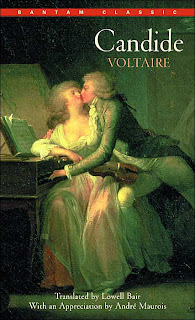
Candide by Voltaire (#9, French Lit)

I am not exactly sure where to start with Candide. I found it amusing, disturbing, thought provoking, and witty. I am startled that I have heard pretty much nothing about either Candide or Voltaire in my lifetime. How have I gone through so many years of education, and even more reading on my own, and never had anyone mention Voltaire?

My goal in 2008 is not quantity, but rather quality--I want to get more out of the book than just finishing it, so I have been doing some research before, during, and after finishing each book. The synopsis on Wikpedia for Candide is almost as long as the book itself! Such a little book has caused quite the scandal over the years. I am always interested in reading books that have been on the Church "do not read" list.

I struggled with the theme behind Candide--the philosophy of optimism. Candide is a young man on a journey, and bad, horrible, terrible, utterly catastrophic things continue to happen to him and everyone he meets. But, when he was younger he was taught by a wise teacher, Pangloss, that everything about the world is perfect, and everything that happens is meant to happen, so he is continually trying to rationalize the evils he encounters. I am optimistic, I believe everything happens for a reason--so I had to figure out what it was about Pangloss' philosophy that is flawed. So basically Candide and I were on the same philosophical journey together from beginning to end. But lucky for me, I didn't encounter earthquakes, storms at sea, whippings, hangings, civil wars, syphilis and many, many more unimaginable events. So unimaginable you have to laugh--really, picture this: four soldiers want to rape you because you are so beautiful, and in the end you don't actually get raped, rather you have been cleanly ripped into four pieces. That's funny, right???

Read this one, it's a gem.

Saturday, March 1, 2008

Atlas Shrugged by Ayn Rand (# 4, Classic)

1069 pages. Ayn Rand's Atlas Shrugged is probably the longest book I have read in years. It was a pleasant struggle to get through. Slow to get into but once you get into it, it is actually quite hard to put down. The build-up and anticipation of what is going to happen between all our heroes is masterfully executed. I gasped so many times while reading and I wanted to call all the people who had already read it so I could talk about all the mini-revelations and connections between characters. I almost want to describe it as a philosophical soap opera--there is drama, it is high stakes, and therefor highly entertaining.

I read Rand's other philosopical work of fiction The Fountainhead in high school so I was not unfamiliar with her writing. I knew what I was getting myself into when I picked this one up and I am glad I did--this book is a must-read for any intelligent person. Rand gives an answer to the question of what would the world be like if there were no great, inventive minds to support society? What if the world's greatest thinkers decided not to use their great minds? What would happen to society if we were left in the hands of looters and moochers--people who are not willing to do things themselves, people unable to answer questions and solve problems?

After reading this book, I have changed the way I think about the word need. Should you give something to someone because they need it? How do you judge whose need is greater than someone elses? I don't think I will ever expect anything from anyone anymore based on a perceived notion of how much I need it. I never want to get something because I need it--I want to work hard for it and know that it is mine because I earned it. I also enjoyed the discussions of love and the questions that provoked. Atlas Shrugged is at heart a love story as well--between the ideals of one man and one woman only this does not become apparent to the reader until much later. The progression of Dagny Taggert's life, how she learns about love, is the most compelling part of this story.

While I loved almost everything about this book--the in depth character development of a multitude of characters, the dramatic exposition, the storyline twists, the well-planned mystery, the philosophical tenets that provided the backdrop for this classic story--I was disappointed by the ending. Seriously, I doubt it would have happened like that. The real climax for me had more to do with the love story than with the actual ending. Read this book!